

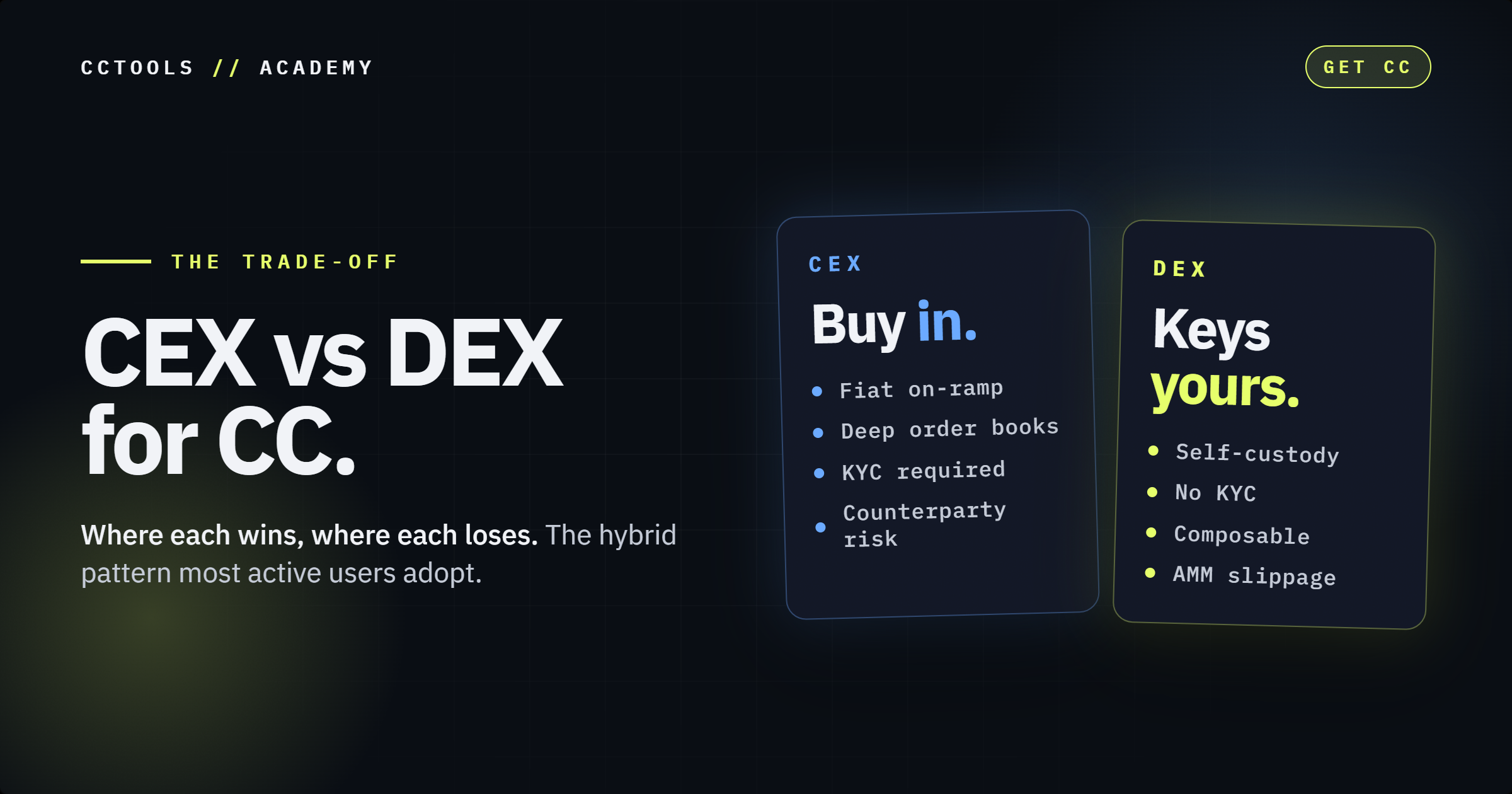
Canton Coin (CC) trades on centralized exchanges (CEXes) and on decentralized exchanges (DEXes) that run on Canton. They are not interchangeable: each is built for different jobs, and each has its own costs.
This article covers what each path is built for, where each fits, one way to use both, and the mistakes that make a trade cost more than it should. CCTools' Get CC tab lists the venues that trade CC, with each venue's KYC status.
01What a CEX Optimizes For
Fiat on-ramp. A CEX accepts money, by bank transfer or card depending on the exchange and your country, and lets you buy CC with it. Most DEXes need you to arrive with crypto already on Canton.
One order book. The price you get is that exchange's own book, whose depth you can see before you trade. It is not the best price across venues.
One app for everything. One account and one balance, without learning about wallets or signing.
Customer support. There is someone to contact if something goes wrong with your account.
The costs: to deposit cash, most exchanges require identity checks (KYC); the exchange holds your assets until you withdraw them, so you carry its counterparty risk; each exchange sets its own withdrawal fee; and an exchange can restrict or freeze an account under its terms.
02What a DEX Optimizes For
Self-custody while you trade. You swap from your own wallet, so you keep the assets while you trade, and no exchange account sits between you and your tokens.
Composability. Apps on Canton can combine a swap with other steps in one all-or-nothing transaction: either every step happens, or none does.
Less paperwork, usually. Many Canton DEXes need no account or KYC to swap, but not all: at least one order book exchange on Canton requires an account with identity checks. The Get CC tab shows each venue's KYC status.
Self-custody still has limits. Your party is hosted by a validator, which must be running for you to transact. Each token's issuer also sets that token's transfer rules, which can limit who may hold it.
The costs: price impact on large trades (on an automated market maker, or AMM, the price comes from the pool's curve), responsibility for your own keys, and no fiat on-ramp on most DEXes.
03Where Each Fits
A CEX fits:
- Turning money into CC for the first time, at an exchange that lists CC and serves your country.
- Turning CC back into money: send it from your wallet to the exchange, sell it there and withdraw the money.
- A large order, when the exchange's book shows a smaller price impact for your size than a pool does. Depth changes from day to day, so compare on the day you trade.
A DEX fits:
- Swaps inside Canton, from your own wallet, without leaving assets on an exchange.
- Steps that an app combines with a swap in one all-or-nothing transaction.
- Times when you do not want an exchange holding your balance.
Providing liquidity is a different activity from swapping: you send both assets to a pool the exchange runs and get pool tokens back, and some exchanges accept liquidity only from approved partners who pass identity checks.
04Using Both: Each Path for What It Does Best
One pattern combines the two paths, using each for what it does best.
A CEX to get in. Open an account at an exchange that lists CC and serves your country; to deposit cash, most exchanges ask you to pass identity checks (KYC) once. Deposit money, buy CC, then withdraw the CC to your Canton wallet. On Canton you withdraw to a party ID, the identity of your wallet's party, rather than to an address as on other networks. Canton transfers can work like requests that the receiving wallet accepts, so check that the exchange supports CC withdrawals on Canton and that your wallet is ready to receive them.
A DEX for activity inside Canton. Once you hold CC and stablecoins such as USDCx in your own wallet, you can swap and rebalance from your wallet, without handing custody of your assets to anyone.
The handover happens at the wallet. Once CC arrives in your own wallet, the exchange is out of the loop until you need money again, which keeps the time an exchange holds your balance short.
The way out mirrors the way in: to sell CC for money, send it from your wallet to an exchange that lists CC, sell it there and withdraw the money.
A related pattern keeps two wallets: a hot wallet in a browser or on a phone for daily activity, and a hardware wallet for funds you rarely move.
05Common Mistakes
Leaving CC on the exchange after the buy. It turns the exchange from a tool into a custody decision: while the CC sits there, the exchange holds it.
Routing small swaps inside Canton through an exchange. Sending CC from your wallet to an exchange, trading there and withdrawing again adds the exchange's withdrawal fee and waiting time, while a swap from your own wallet settles in one transaction.
Sending a large order to one venue without checking it. A large buy walks down an order book, or along an AMM's curve, and each step costs more than the last, so the average price worsens as the size grows. Check each venue's quote or order book for your size before you confirm.
The pattern: pick the venue built for your specific job, not the one that is most familiar.