

On this page5
To become a Featured App on Canton, a project locks up Canton Coin. Not a little. A standard app locks 5 million CC. An asset issuer locks 25 million, roughly 3.75 million dollars, frozen on-chain, just to be allowed to compete.
That sounds steep. It is supposed to be. And it just created one of the most interesting markets on the network, a project called Cashen, whose tagline puts it simply: "Credit flows on Canton."
The clever part: you have to earn your spot twice
Here is what makes Canton's design unusual, and worth understanding. That lock is not arbitrary; it is written into the network's rules. Featured Apps lock under CIP-116 (Featured App Locking), and Super Validators face a parallel requirement under CIP-105 to keep their full reward weight. But the lock only buys you the right to play. On most chains, locking up enough tokens is the whole game: you stake, the rewards flow, you coast. Canton refuses to let you.
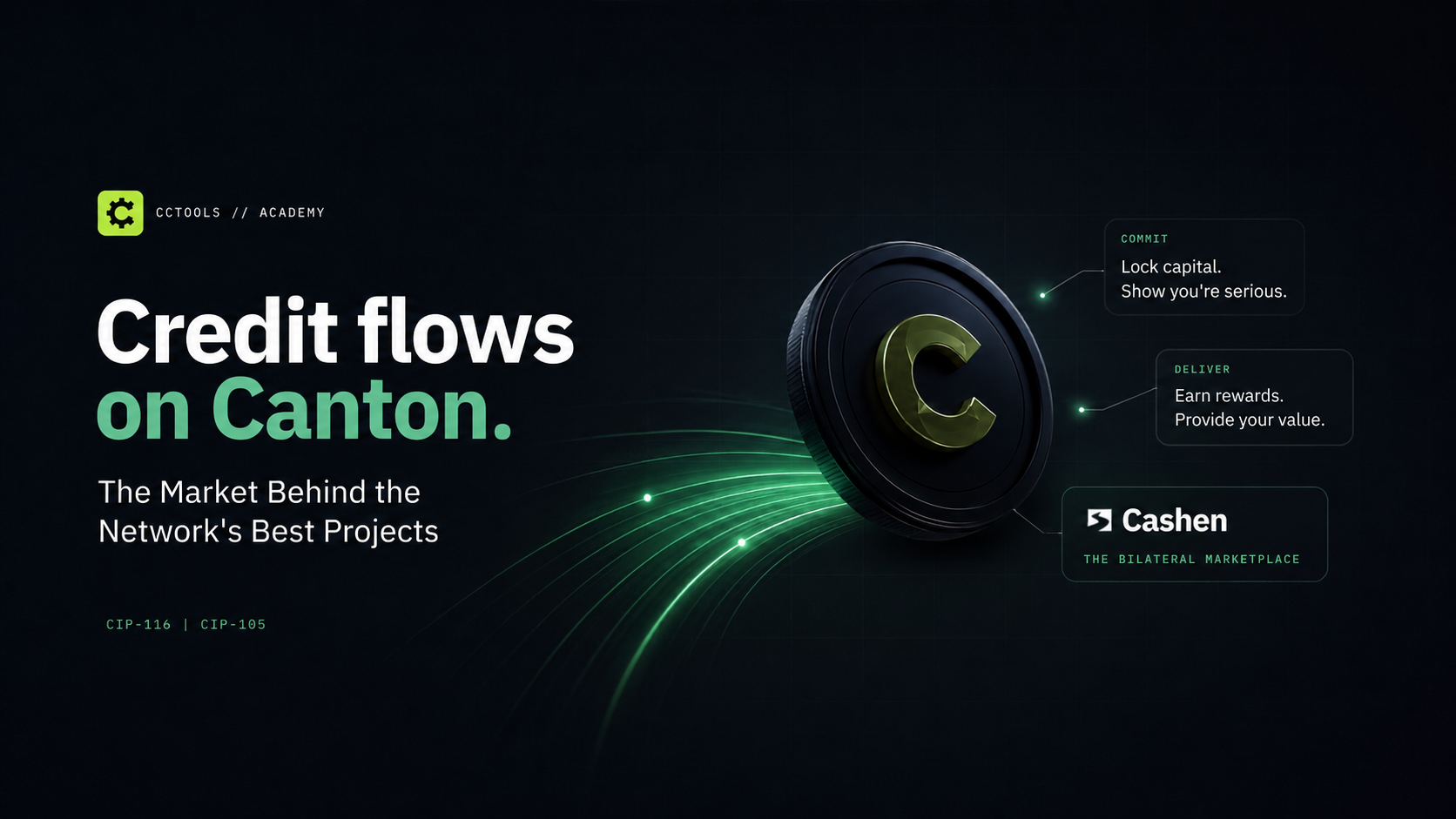
What you actually earn comes from somewhere else entirely: real usage. Under CIP-104, Featured Apps earn Canton Coin from the actual traffic they drive, settled on-chain roughly every ten minutes, in proportion to the fees their activity burns. So a project can lock 25 million CC, sit idle, and earn nothing. Canton asks for two separate things: commit (put up the capital to show you are serious) and deliver (earn your rewards by actually being used).
It is a quietly brilliant way to run a token economy. You cannot buy your way to the top, and you cannot meme your way there either. You have to do both. The lock is the network's way of asking who is serious; the rewards are its way of paying who is useful.
The gap that opened up
Which leaves a problem. Locking millions of CC is a lot of capital to freeze, and some of the strongest teams arriving on Canton simply do not have it sitting idle. Meanwhile, plenty of large CC holders are sitting on exactly that, parked, doing nothing, earning nothing.
The network wants more serious projects to commit. The capital to let them is right there. It just is not in the same hands. When a need and a supply sit that close together, someone builds the bridge between them. On Canton, that someone is Cashen.
Cashen: turning a requirement into a market
Cashen is a marketplace for these locks. A CC holder backs a project by locking and delegating their coins to it, and earns a fixed return for doing so, without ever giving up custody. The project gets the committed capital it needs to take its seat in the ecosystem. The holder turns parked CC into a yield. Both sides get the half of the deal they actually wanted.
The effect on the network is the whole point. More genuinely strong projects can clear the bar, because they no longer have to own millions of CC to do it. And because the rewards still only flow to apps that drive real activity, nobody games their way in. Cashen widens the door without lowering the bar.
This is not a DeFi free-for-all, either. Every deal is negotiated one to one and fixed at signing, access is gated by KYB, the assets sit with a qualified custodian (Copper or BitGo) or in Canton wallets, and the liquidity comes from an extensive network of large institutional CC holders. It reads less like a yield farm and more like an institutional credit desk, which is exactly what Canton was built for.
And the timing is real. CIP-116 is rolling out now, which means the wave of projects moving to lock their CC is happening today, not someday. The apps that secure their capital early take their Featured seats first, and the holders who supply that capital early are the ones already earning on it. On Cashen, both sides are already showing up.
How a deal works, and the one detail worth pausing on
Open Cashen and it looks like a two-sided order book. Projects post what they need; holders post what they will offer. Each deal carries the terms you would expect from a real credit agreement: a fixed rate, a minimum lock period, a recall notice, the specific app or validator the capital is pointed at, and a higher penalty rate if things go sideways.
But the detail worth pausing on is substitution. Normally, if the holder behind your lock wants their CC back, you have a problem: your locked total drops, and your standing drops with it. Cashen solves it by quietly swapping in a new holder before the old one leaves, settled on the platform, so your lock never actually breaks. The capital behind your commitment can rotate freely, and from the network's point of view, nothing ever moved. Your standing stays exactly where it was. It maps to a real Canton primitive (the Supplier Substitution spec), so this is engineering, not a marketing line. Throughout, custody stays with the holder, who is lending the use of their CC, not handing it over, and carries no principal credit risk.
Why it matters for Canton
Step back and the picture is bigger than one app. A network where committed capital can be priced, put to work, recalled, and seamlessly substituted is not a database with a token bolted on. It is starting to behave like a financial system. Canton was built for exactly that: privacy, atomic settlement, real-world assets at institutional scale. A working credit market growing on top of it is one of the clearest signs yet that it is maturing into the real thing.
The healthiest networks are the ones where serious players put real capital on the line and real builders get paid for delivering. Canton is becoming one of those. Cashen is part of why.