

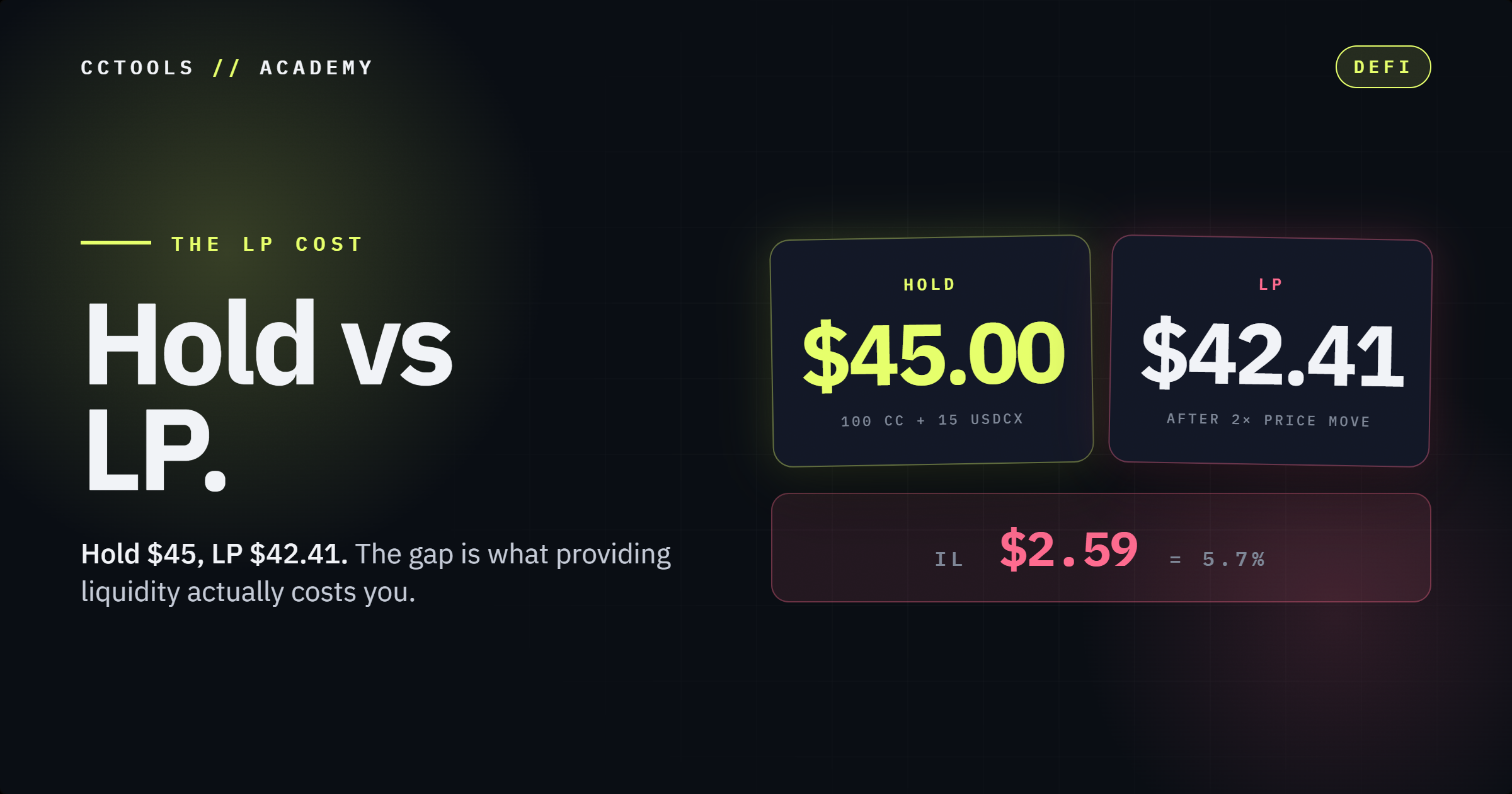
If you've researched providing liquidity on a Canton DEX, you've probably seen the warning: 'beware impermanent loss.' What it actually means, and how big it can get, is easy to get wrong.
This article walks through the math, the breakeven point against the fees a pool earns, and how to read a pool's numbers with IL in mind. Whether an LP position ends ahead of just holding depends on how far the two prices move apart and on how much fee income the pool's volume produces relative to its TVL. The examples are hypothetical; TVL, trading volume and fee APR for Canton pools are on /markets/defi.
01What Impermanent Loss Actually Is
An AMM pool's reserves are constantly rebalanced by arbitrage. When the external market price of one token moves, arbitrageurs trade against the pool until the pool's implied price catches up. Each rebalancing event extracts a small amount of value from the LP, transferring it to the arbitrageur as their profit.
This is impermanent loss. The 'impermanent' part is real: if the price returns to where you deposited, the pool returns to its original ratio and the loss disappears. But if prices end somewhere else when you withdraw, the loss is locked in.
IL is NOT a fee, and it's not a bug. It's the structural cost of providing a liquidity service to traders. The fees the LP earns are meant to compensate. The question is always: do the fees outweigh the IL?
02Worked Numbers
Standard formula: if the price of one token against the other moves by a factor of r from your entry, the impermanent loss for a 50/50 constant-product pool is:
IL = 2 * sqrt(r) / (1 + r), minus 1
Worked scenarios (hypothetical moves of CC against USDCx):
Price 2x (CC doubles): IL = -5.7%. Your LP position is worth 5.7% less than just holding the underlying tokens.
Price 4x (CC goes 4x): IL = -20%. Significant. Fees would have to make up that 20% gap to match holding.
Price 0.5x (CC drops by half): IL = -5.7%, the mirror of the 2x case.
Price 0.25x (CC drops to a quarter): IL = -20%, the mirror of the 4x case.
Smaller moves cost much less, and a fall costs more than a rise of the same size: about 0.11% for a 10% rise and 0.14% for a 10% fall, 0.41% and 0.62% at 20%, 0.85% and 1.6% at 30%. Past 2x the loss grows quickly. Pools where the two tokens track each other (two dollar stablecoins, for example) have near-zero IL while both hold their peg, because their prices barely diverge.
03Fees Against IL: the Breakeven Calculation
Fees accumulate with every swap; IL accumulates with price divergence. The question is whether the fees earned while you are in the pool cover the IL at the price where you withdraw.
Quick estimate: fee income for a period = LP fee rate * volume in the period / TVL. Use the LP's share of the swap fee; on some venues part of it goes to the operator. A hypothetical CC/USDCx pool with a 0.30% LP fee, $1M of monthly volume and $500k of TVL pays its LPs 0.30% * $1M / $500k = 0.6% of TVL that month.
Against that, IL depends on where the price is when you withdraw, not on the path. If CC ends the month 20% higher, IL is about 0.41% and the fees cover it. If it ends 20% lower, IL is about 0.62%, roughly equal to the fees.
If CC doubles in a month, IL is 5.7%. The fees cover about a tenth of it, and the LP trails holding by roughly 5% that month.
The core ratio is volume / TVL, set against the move you want to test: the volume needed to break even, as a multiple of TVL, is the IL divided by the LP fee rate. At a 0.30% LP fee that is about 1.4 times TVL for a 20% rise, 2.1 times for a 20% fall and 19 times for a doubling or halving. Pools with little volume relative to TVL earn little to offset IL, so they only keep up with holding while the two prices stay close.
04How to Read /markets/defi for IL Risk
When scanning the /markets/defi table, remember that the APR column is fee income annualized from past volume: it does not include IL. Mentally annotate each row with its IL profile:
Stable-stable (two USD stablecoins): IL near zero while both tokens hold their peg. If one loses its peg, the pool ends up holding more of it.
CC-stable (CC/USDCx): IL follows CC's move against the dollar, as in the figures above.
CC-volatile (CC against another volatile token): IL follows the ratio between the two prices, not either price in dollars. If the two move together, IL stays small; if they move apart, it grows by the same formula.
Pairs without CC (a volatile token against a stablecoin, for example): the same formula, driven by that token's move against the dollar. The size of the move sets IL, not the pair type.
A high APR on a small pool can come from a few large trades. In a hypothetical $5k pool with a 0.30% LP fee, $200 of volume a day works out to about 4.4% APR, and a 50% APR needs about $2,300 a day; new deposits would also spread the same fees over more TVL. IL does not shrink with pool size: a 50% fall in one token against the other costs 5.7%, a 50% rise 2.0%. Cross-check the volume/TVL ratio every time.
05Mitigations and Edge Cases
Some AMM designs change the trade-off. Concentrated liquidity (for example Uniswap V3, outside Canton) lets you set a price range, so your liquidity earns fees only while the price is inside it. Inside the range, the same move costs more IL than in a full-range pool, because the capital covers a narrower band of prices. Outside it, the position earns no fees and holds only the token that lost value against the other. That is not a 100% loss, but the gap to holding widens as the price moves further away.
Dynamic fees (some V4-style designs) raise fees during volatile periods. Stable-asset pools (Curve-style) use a different math that minimizes slippage for correlated pairs.
Tradecraft's API documentation, read on 15 Oct 2026, describes its pools as constant-product pools (its quotes use the constant product formula), so the formula above applies to them directly; Tradecraft is one of the venues whose pools /markets/defi reads live. For any other venue, check how its pools price before applying the formula. With concentrated liquidity, a narrower range earns more fees per dollar while the price stays inside it, magnifies IL and leaves the range after a smaller move, which is why such positions need active management.