

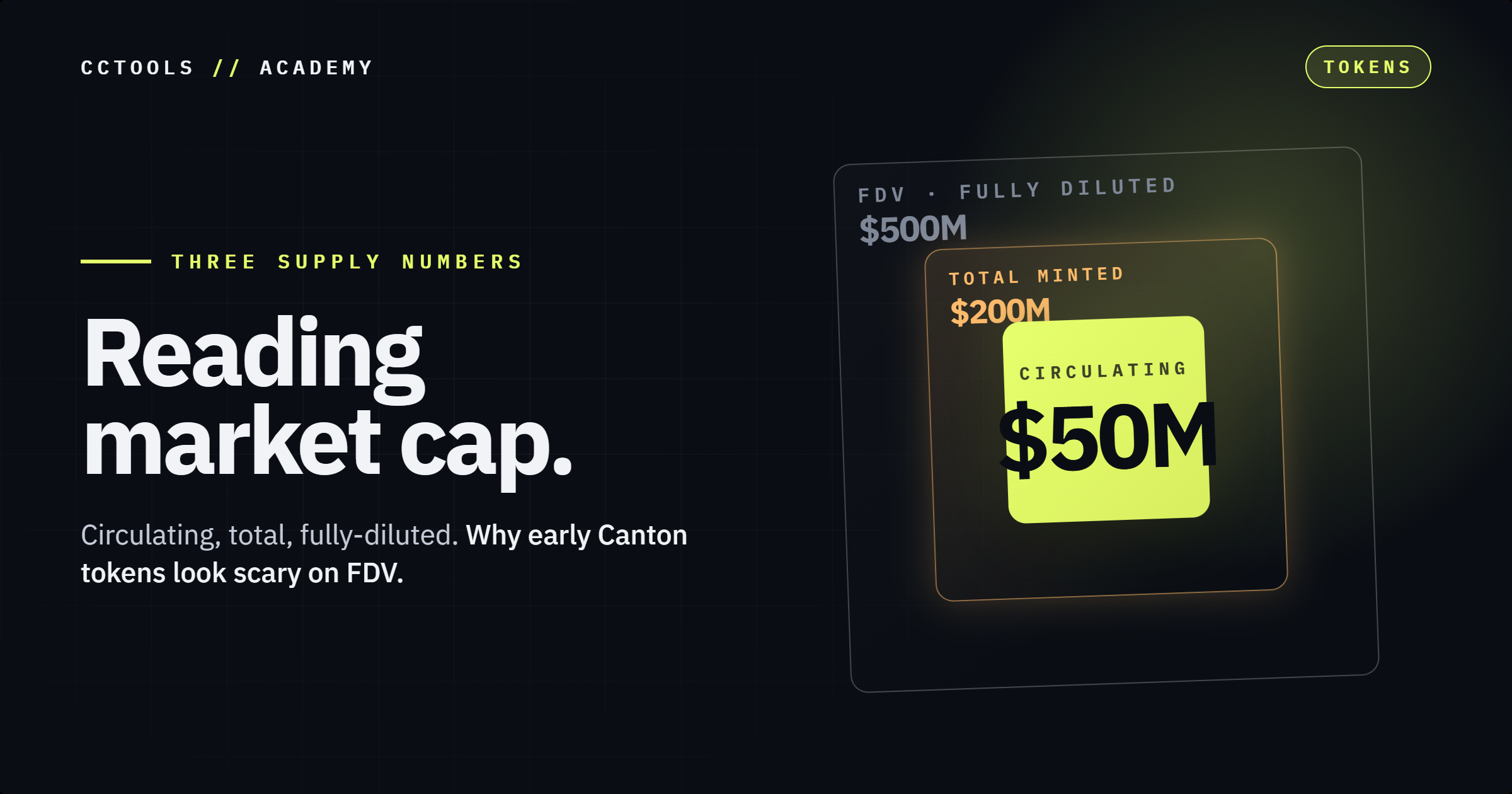
Market cap is the most-quoted token metric and one of the most misread. Price times supply looks simple, but which supply goes into it changes the answer a lot, especially for young tokens whose supply is still being released.
This article covers the three supply numbers (circulating, total and fully diluted), how vesting changes them over time, what on Canton you can and cannot check publicly, and a few checks that catch common ways market cap misleads.
01Three Supply Numbers
Circulating supply. Tokens that can trade today: held by independent holders, not locked in vesting, a team treasury or locked liquidity.
Total supply. Every token issued so far, including locked allocations, some of which cannot move yet.
Fully diluted valuation (FDV). The price multiplied by the maximum supply the token will ever have, where there is one. It shows what the market cap would be if every token existed and traded at today's price.
A hypothetical example: a token with 50M tokens circulating, a maximum supply of 1B and a price of $0.10 has a circulating market cap of $5M and an FDV of $100M. The 20x gap is supply still to come.
On Canton, the total supply of a token issued under the token standard (CIP-0056, with version 2 in CIP-0112) is the figure its issuer's registry publishes; because holdings are private, no one else can recount it. Canton Coin's supply, by contrast, comes from the network itself.
02How Vesting Changes Supply Over Time
Many tokens launch with only part of their supply circulating. Team and investor allocations are often locked for a period, sometimes with a cliff: nothing is released until a set date, then a steady release follows.
The release calendar sets future supply. A hypothetical token with 10% of its supply circulating and nothing released for 12 months has a stable supply for that year. The same token releasing another 10% in month 6 doubles its circulating supply that month, and the new supply has to find buyers.
So read the release calendar, not only the current number. A project usually publishes its schedule in its own documentation. On Canton, tokens held under a vesting contract are private like other holdings, so the public usually cannot check the schedule on-chain.
03Circulating Supply Isn't the Same as Tradeable Float
Circulating supply counts everything that is not locked, but a few holders may own most of it. A hypothetical token with 50M circulating, 30M of it in three wallets, has an effective float of about 20M. Those holders may never sell, or may be waiting to.
On most public chains you can check this with an explorer's top-holders view. Canton is different. Canton Coin holdings can be read from the network's public Scan API, so CC's holder distribution can be computed. Other tokens on Canton, issued under the token standard, are private: a holding is visible only to the parties involved, such as the holder and the token's issuer, and to the validators that host them. There is no public top-holders view for those tokens, so holder concentration is something only the issuer can report.
A thin float means small buys move the price a lot, the headline market cap overstates the market's real size, and a chart can make a small buy look like a trend.
04FDV: When the Gap Matters
A large gap between circulating market cap and FDV means a large share of the supply has not reached the market yet. It is not good or bad on its own; it tells you where to look next:
A small gap, a few times or less: most of the supply already exists and trades.
A large gap, ten times or more: much of the supply is still to come. Whether the price holds depends on demand keeping up as supply grows, so the release calendar matters.
A very large gap, a hundred times or more: today's price is set on a small float, and FDV shows the scale of what is still to arrive at that price.
05What to Check Beyond Market Cap
Beyond the circulating market cap, a few things shape what the number means:
The release calendar: the size and date of the next large release.
Holder concentration: how much the largest holders own, where it can be checked or the issuer reports it.
Volume against market cap: how much actually trades against the headline figure.
What the token does: what holding or using it gives, as its issuer describes it.
Where the token lives: whether it was issued on Canton or brought from another chain. A bridged token can exist in several forms, and its supply on Canton is only part of the total.
Market cap is a starting point, not a verdict. CCTools' Tokens tab shows each token's price and market cap where a price source covers it.