

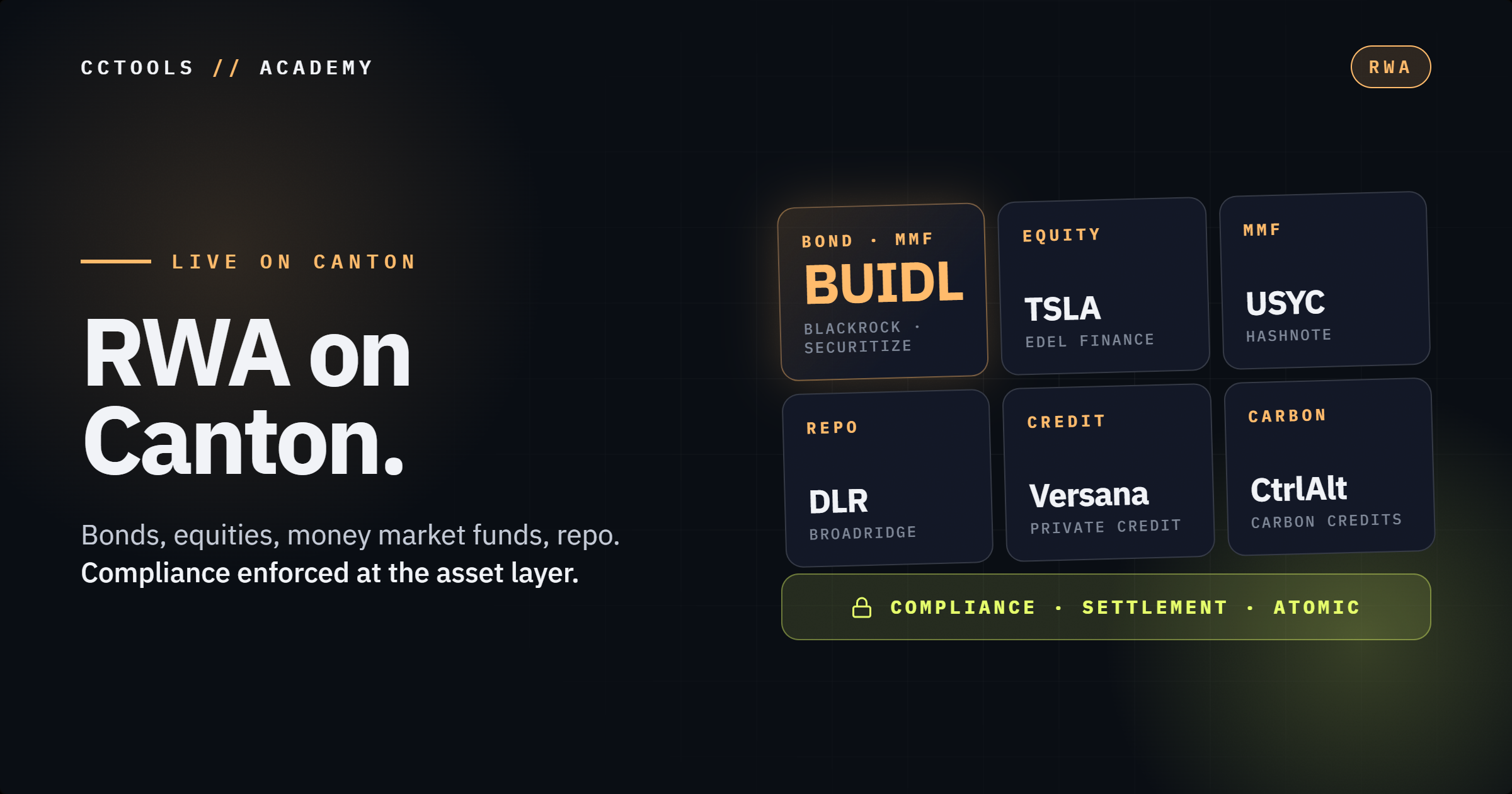
Real-world assets (RWA) on Canton are tokenized versions of instruments such as bonds, equities and money market fund shares. The token records the holder's claim on the underlying asset, which itself stays off-chain with the issuer or its custodian. Tokenizing real-world assets is one of the main uses Canton was built for, alongside private settlement between regulated institutions.
This article covers what Canton offers an issuer of such assets, how an asset's rules can live in its contracts, how settlement works, and what of this a retail user can reach today.
01Why Canton for RWA
Three properties of Canton matter to issuers of regulated assets:
Privacy by default. Each party sees only the parts of a transaction it is involved in, and so do the validators that host those parties; the synchronizer that orders transactions sees only encrypted messages. A bond trade between two counterparties is not broadcast to the whole network, which is how trade settlement works in traditional finance.
Party-level permissioning. Every holder on Canton is a party, and an asset's contracts can restrict which parties may hold or receive it. A fund share issued to qualified investors can be written so that it cannot move to a party outside the issuer's list.
Daml smart contracts. Assets on Canton are defined in Daml, where each contract names the parties that must authorize each action on it. A bond's transfer rules, settlement steps and who may see what can be written into its contracts, and every transaction is checked against them.
Together, these let an issuer put its holding and transfer rules in the asset itself, instead of in a separate layer.
02What's on Canton Today
CCTools tracks real-world assets on Canton in two places. The RWA tab of CCTools Markets lists issuers and venues where a retail user can act on Canton. CCTools' ecosystem directory lists the rest, including institutional platforms for repo and bonds that serve institutions only.
On the RWA tab, last checked on 4 Oct 2026, the live entries include tokenized private-company equity and cap tables (Fairmint, whose holdings are visible only to their parties) and markets that trade the price of real-world assets without holding a token of the asset, such as perpetuals on gold and stocks and a prediction market on pre-IPO companies. A Bitcoin-backed token has been announced for Canton but is not on the network yet.
Many categories are still early, and much of what exists serves institutions first. Holdings on Canton are private, so an asset can be in use without any public figure showing it.
03Rules Written Into the Asset
On Canton, the rules of an asset can be part of the Daml contracts that define it. An issuer can write rules such as: only parties on an allowlist may hold the token, transfers above a set amount need an agent's approval, or transfers settle only in certain hours. Under the token standard (CIP-0056, with version 2 in CIP-0112), each token's registry, run by its issuer, supplies the logic its transfers go through.
Those rules are checked as part of each transaction. A transfer that breaks them is rejected as a whole, and the asset stays where it was.
The protection is only as strong as the rules the issuer writes: Canton enforces the contract as written, and a token whose contract has no restrictions has none. For issuers, the benefit is that the rules travel with the asset instead of living in a separate compliance service. The trade-off: rules written into the asset are harder to change later than a policy kept off-chain.
04Settlement: Atomic and Final
When two parties trade a Canton asset against a payment that is also on Canton, settlement can be atomic: the asset and the payment move in the same transaction, or neither moves. This is delivery versus payment (DvP), the standard model for settling securities.
The same can hold for other events, as far as the issuer builds them that way. A fund share can be redeemed in the same transaction that pays the holder, when the payment is itself a token on Canton, such as a stablecoin. When the cash moves off-chain, through a bank, that step happens outside the Canton transaction.
Finality is not probabilistic. Canton commits a transaction in two phases: the parties' validators confirm it, and once the mediator approves it, it is final. There are no block confirmations to wait for.
05What a Retail User Can Reach
Access depends on the asset.
Tokenized money market funds are usually sold only to qualified or institutional investors. Circle said in January 2025 that its tokenized fund USYC is supported on Canton; Hashnote's USYC onboarding documentation says it is accessible only to institutions outside the United States, subject to eligibility rules and a minimum of US$100,000.
The institutional platforms for repo and bonds in CCTools' ecosystem directory serve institutions only.
What a retail user can act on is what the RWA tab lists. Each entry says what it offers, and each has its own access rules, so check an issuer's eligibility and identity checks before you plan around an asset.