

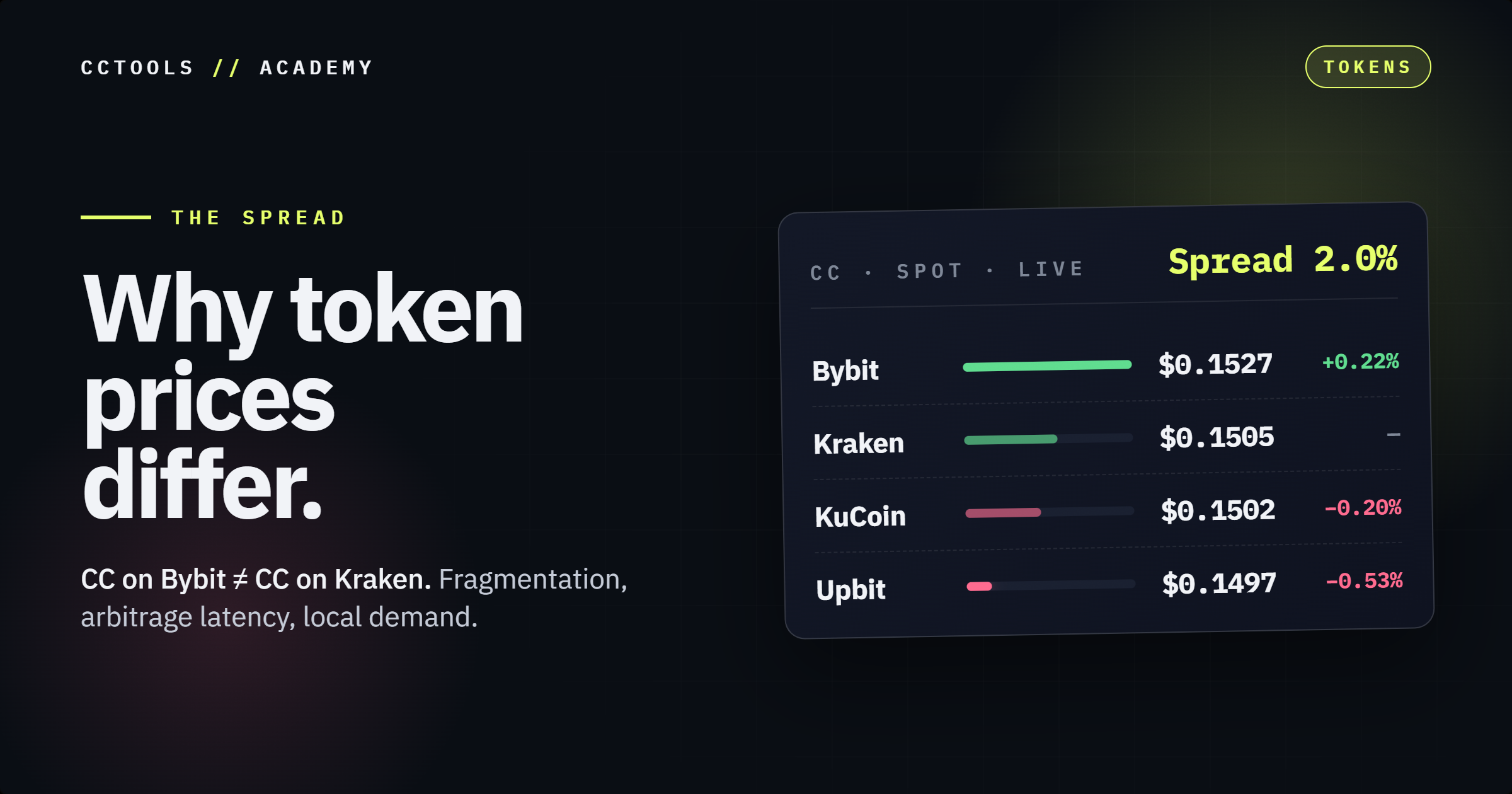
Open CCTools' Get CC tab and you will see CC priced slightly differently on each venue. Same asset, same moment, different numbers. This is normal, and the reasons it happens tell you which number to use for what.
This article explains three structural reasons prices diverge across venues, what a reference price is, and why a quoted price is not always one you can trade at.
01Reason 1: Fees and Spreads Differ
Each venue charges its own trading fees, usually a maker fee and a taker fee, and the price it displays does not include them. The displayed price is often the mid-price, halfway between the best bid and the best ask. A buyer who takes the ask pays more than the mid, and pays the taker fee on top.
So two venues that show different mid-prices can end up closer together, or further apart, once each one's spread and fee are added. A hypothetical example: venue A shows $0.1527 with a 0.10% taker fee, and venue B shows $0.1505 with a 0.16% fee. With fees, A costs about $0.1529 and B about $0.1507, a gap of about 1.4%, before either spread.
The comparison that counts is the price you would actually pay, spread and fee included, not the displayed mid.
02Reason 2: Local Demand
Venues serve different regions and quote CC against different currencies. On the Get CC tab, for example, Upbit's fiat currency is the Korean won, while most other exchanges list US dollars or euros. Local demand moves local prices, and moving money between a local currency and the global market can be slow or restricted, so a regional price can stay apart from the rest.
The best-known example is the 'kimchi premium', when Bitcoin traded higher on Korean exchanges than elsewhere.
When one venue's price sits well apart from the others, ask whether it is a local-demand effect, an arbitrage window, or a technical issue such as a paused withdrawal or a stale quote.
03Reason 3: Arbitrage Takes Time
Even without local effects, prices drift apart briefly because arbitrage takes time. A buyer lifts the ask on one venue, and until someone trades on another venue to close the gap, the two prices disagree. For assets with a lot of arbitrage capital the gap closes fast; for assets with less, it can last longer.
An apparent gap is not the same as a profit. Buying on one venue and selling on another costs two sets of trading fees, a withdrawal fee and the time a transfer takes, while prices keep moving. Those costs often take most of an apparent gap.
04What 'Reference Price' Means
Price services combine many venues into one reference price. CoinGecko, for example, collects price, volume and liquidity data from the exchanges it tracks, combines them into one market price and filters out outliers, according to its methodology page. A venue with more volume counts for more than a small one.
On the Get CC tab, the CC card at the top shows that kind of aggregate figure: CC's price, market cap and 24-hour volume from CoinGecko, with CoinPaprika as a fallback. The table below it shows each venue's own price and 24-hour CC volume.
A reference price describes CC's value in general; a venue's own order book is what a trade there will execute against.
05Tradeable vs Quoted
A venue can show a price you cannot act on. Common reasons:
Withdrawal pause. A venue can halt CC withdrawals, for example during upgrades or compliance reviews. You can buy there but not move the CC out.
Minimum trade size. Some venues set a minimum order. If it is larger than what you want to buy, the quote does not apply to you.
Stale quote. On smaller venues the displayed price can lag the real order book during fast moves.
Identity checks. The venue lists CC but requires KYC before you can trade. Until your checks clear, its current price is not available to you.
Before acting on a price gap, check that the venue allows what you want to do, buying and withdrawing, at your size, today. The Get CC tab shows each venue's KYC status; fees, minimums and maintenance notices are on the venue's own pages.