

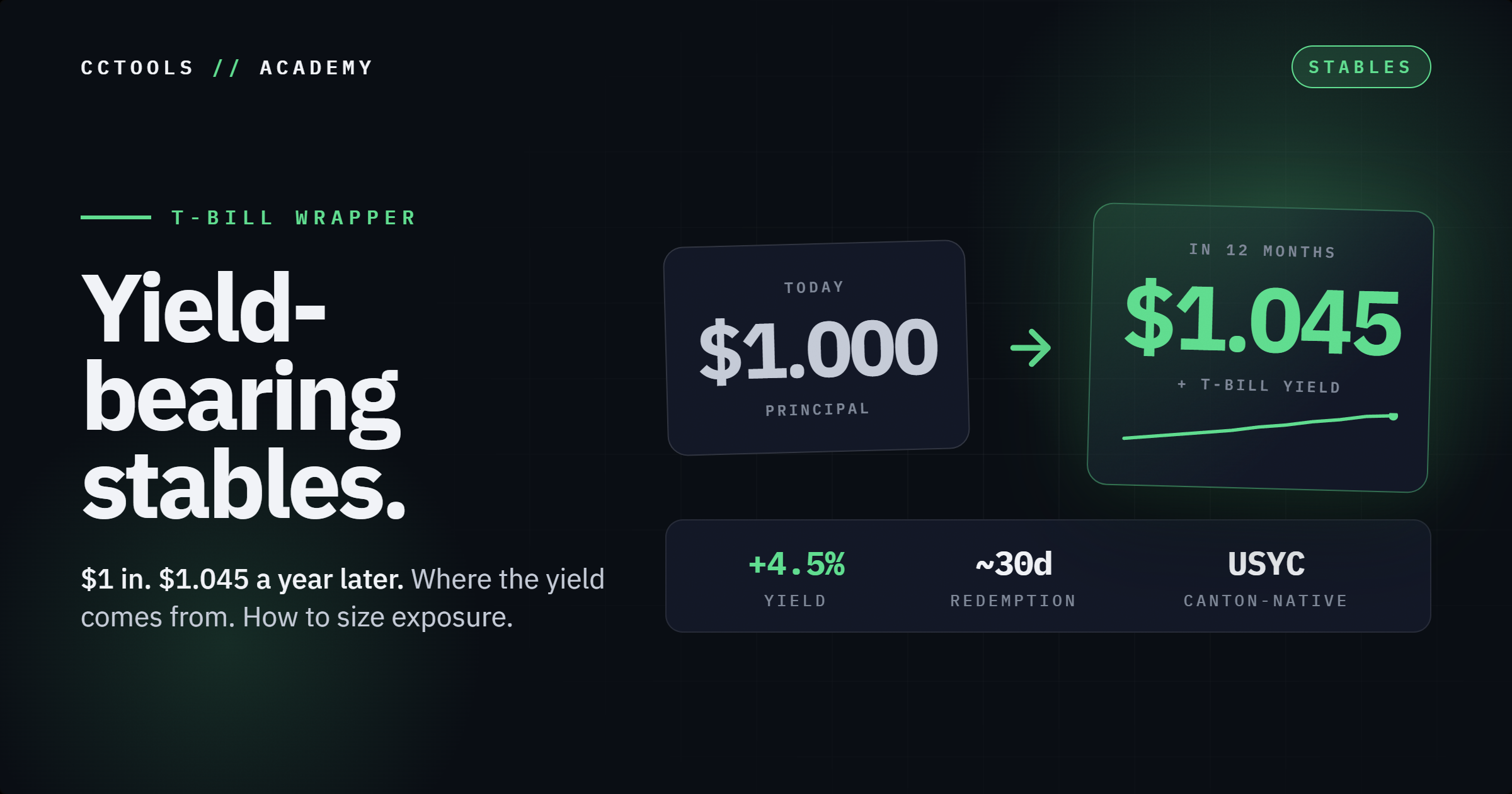
A plain stablecoin aims to hold $1 and pays its holder nothing; the issuer keeps the income from the reserve. A yield-bearing stablecoin, or a tokenized money market fund, passes part of that income to holders. The income usually comes from short-term US Treasury bills (T-bills) and similar instruments held in the reserve or the fund.
This article explains where that income comes from, the two ways it reaches holders, the risks that come with it, and what CCTools' data shows on Canton today. Canton itself pays nothing to holders of any token: the income in this article comes from an issuer's reserve, not from the network.
01Where the Yield Comes From
The issuer or the fund holds short-dated US Treasury bills, and sometimes repurchase agreements (repo), instead of cash alone. Those instruments pay interest that tracks short-term US interest rates.
The issuer passes part of that interest to holders and keeps a fee. So the rate holders receive moves with short-term US rates, less the issuer's fee: it falls when those rates fall, and it would be close to zero if they were.
The income depends on what the reserve holds. A reserve that moves into riskier assets changes the risk of the token, which is why the issuer's reports on its holdings matter.
02Two Ways the Yield Reaches Holders
Rebasing. The number of tokens in your balance grows over time, while each token stays at about $1.
Rising value. The number of tokens stays the same, and the value each one redeems for rises. USYC works this way: its token price is the fund's net asset value divided by the tokens in issue, and new investors buy in at the current price, according to Hashnote's USYC documentation. A price above $1 on such a token reflects the income it has built up; it is not a stablecoin losing its peg.
03The Risks That Come With the Yield
These tokens can look like a better version of a plain stablecoin, but they work differently.
Many are fund shares, not stablecoins. A token such as USYC is a share in a fund that holds T-bills and repo. You hold a claim on the fund, so its manager, custodian, administrator and redemption terms all matter.
Liquidity. A widely used stablecoin trades on many exchanges at all hours. A tokenized fund share usually trades on far fewer venues, and turning it back into cash depends on the issuer's redemption process.
Redemption terms. A fund can limit or delay redemptions under its terms, for example when many holders ask for cash at once.
Access. Many of these products are open only to some investors. Hashnote's USYC onboarding documentation says USYC is accessible only to institutions outside the United States, subject to eligibility rules and a minimum of US$100,000, after the fund administrator's KYC checks, and only to wallets that have been allowlisted.
Rules can change. Regulation of yield-bearing tokens is still developing, so who may hold one, and where, can change.
04Questions to Ask Before Holding One
- What does the reserve or the fund hold, and who reports on it?
- Who may hold the token, and does your wallet need to be allowlisted?
- How and when can it be redeemed for cash, and what can delay that?
- Does the yield reach you as more tokens or as a higher price per token?
- Where does it trade, and how deep is that market on the day?
05What CCTools' Data Shows on Canton
In January 2025, when Circle announced its plan to bring native USDC to Canton, it said that USYC was already supported on Canton. CCTools' Stablecoins tab, last checked on 2 Oct 2026 against the venue feeds, its asset tracker and CoinGecko's Canton listings, does not list USYC, because none of those sources showed it. Holdings on Canton are private, so a token can be in use without appearing in public data.
The same check lists no coin on Canton as yield-bearing. Coins whose backing CCTools has not reviewed yet are marked as not reviewed.
USDCx, the stablecoin on Canton backed by USDC through Circle xReserve, is a plain stablecoin: it does not pay its holders.