

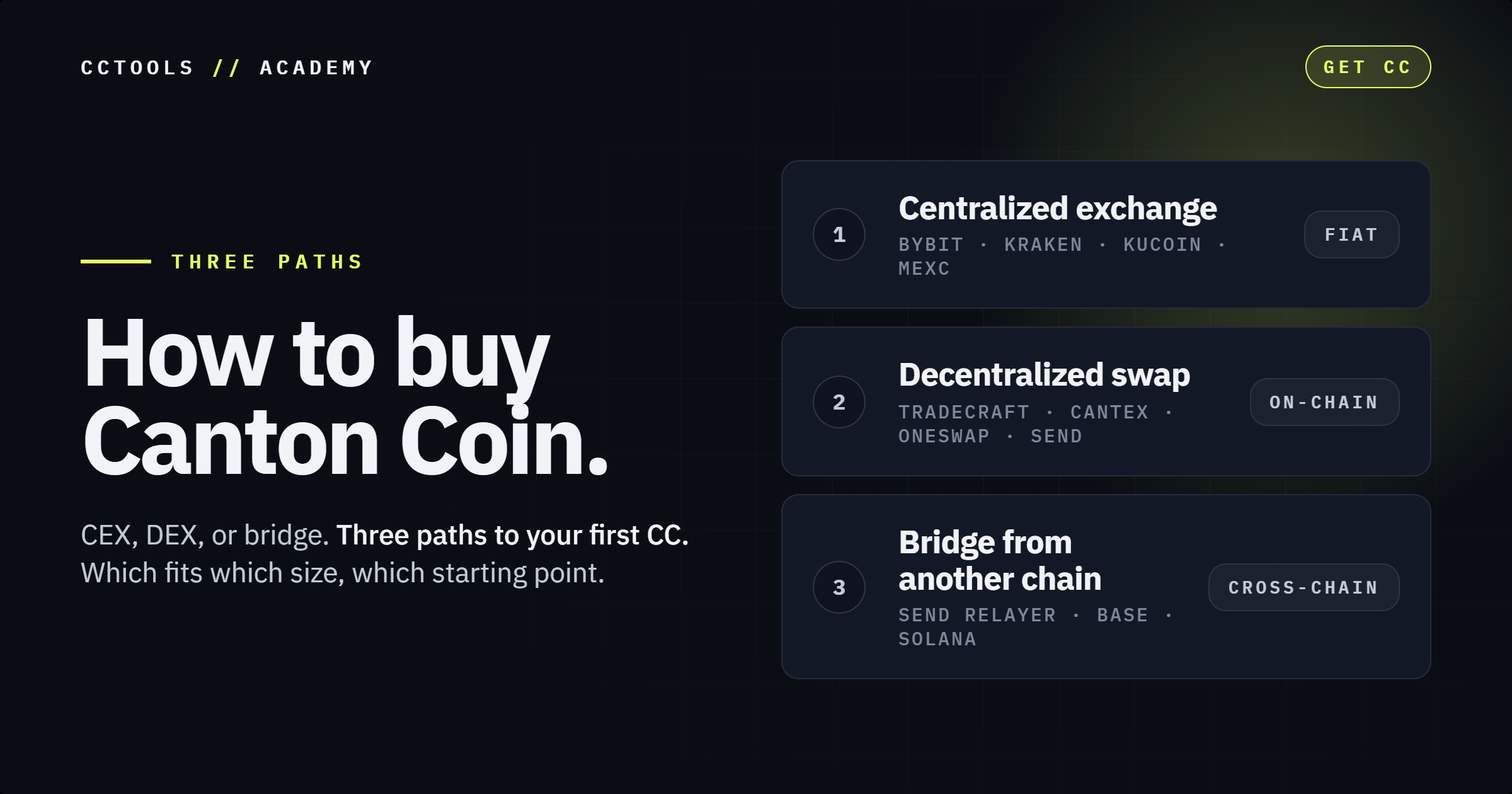
If you hold no Canton Coin (CC) today, there are three ways to a first balance: buy it on a centralized exchange (CEX), swap for it on a decentralized exchange (DEX) on Canton using crypto you already hold there, or bridge an asset from another chain and then swap. Each fits a different starting point.
This article walks through the three, what each costs in general terms, and what changes with the size of the buy. Fees and depth change from day to day, so it gives no fee table: CCTools' Get CC tab lists the venues that trade CC, and each venue shows its own fees before you confirm.
01Path 1: Centralized Exchange
Open an account at an exchange that lists CC and serves your country. Deposit money by bank transfer or card, or deposit a stablecoin, depending on what the exchange accepts. Buy CC on a CC pair, then withdraw the CC to your Canton wallet.
Costs: to deposit cash, most exchanges require identity checks (KYC); a few make it optional, and the Get CC tab shows each venue's KYC status. Each exchange sets its own trading fee and its own CC withdrawal fee. A flat withdrawal fee weighs more on a small withdrawal than on a large one.
The withdrawal goes to a party ID, the identity of your wallet's party on Canton, rather than to an address as on other networks. Canton transfers can work like requests that the receiving wallet accepts, so check that the exchange supports CC withdrawals on Canton and that your wallet is ready to receive them.
Fits: you hold money but no crypto yet. A CEX is the usual way to turn money into CC.
02Path 2: Decentralized Exchange
If you already hold an asset on Canton, such as a stablecoin like USDCx, you can swap it for CC on a Canton DEX from your own wallet. CCTools' DeFi tab lists the pools it reads, with their TVL, volume and APR.
Costs: each pool sets its swap fee, and some apps add a fee of their own. Many Canton DEXes need no account or KYC for a swap, but not all.
Network fees: you do not need a separate balance for gas, as on Ethereum. Canton has traffic fees instead of gas: the validator that submits your transactions pays for the traffic they use, beyond a small free allowance, by burning CC. Since CIP-0078 (approved 15 Sep 2025), CC transfers carry no transfer fee.
Time: the swap settles in one transaction once you sign it.
Fits: you are already on Canton and want CC without leaving your assets with an exchange. Not a fit if you start from money: you need an asset on Canton first.
03Path 3: Bridge From Another Chain
If you hold an asset on another chain, you can bridge it to Canton first and then swap it for CC on a Canton DEX. CCTools' Bridges tab lists the live routes into Canton, with the asset each issues and, where the operator states it, how each is attested. For example, USDC on Ethereum becomes USDCx on Canton through Circle xReserve.
Costs: the bridge's own fee, the network fee on the source chain, and then the swap fee on Canton.
Time: it depends on the route. For USDC from Ethereum through xReserve, Digital Asset's xReserve documentation says Ethereum finality typically takes 13 to 15 minutes. After that, the deposit is attested on Canton and USDCx is minted: automatically if you turned on pre-approval for your party, otherwise when you confirm the mint.
Fits: you hold assets on another chain and would rather not open an exchange account just for CC.
04Which Path at Which Size
Small buys: fixed costs dominate. A flat withdrawal fee from an exchange, or the fixed costs of a bridge and a swap, are a larger share of a small amount, so compare the total cost of each path for your amount.
Large buys: depth dominates. A large buy walks down an order book, or along an AMM's curve, and each step costs more than the last, so the average price worsens as the size grows. How fast depends on the book's depth or the pool's size, and both change from day to day. Check each venue's quote or order book for your size before you confirm.
The CEX vs DEX article compares the two kinds of venue in more detail.
05What Happens After You Buy
Once CC is in your Canton wallet, you can hold it, swap it, provide liquidity in a pool, or send it to an exchange to sell. Holding CC earns nothing from the protocol, and you do not need to keep any for gas.
A common mistake is leaving CC on the exchange after the buy. While it sits there, the exchange holds it, not you. Withdrawing it to your own wallet is what moves custody to you.
For wallets, see the wallet article. For pools to swap in or provide liquidity to, see the DeFi tab.